
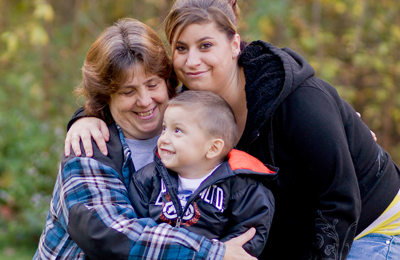
Ryan Kauffman, 11
Ryan has a big heart and has learned to apologize when he is wrong.
Reading between the lines — living with Asperger’s syndrome.
Sometimes things get lost in translation for Ryan Kauffman. An innocent comment that “it’s raining cats and dogs outside” can frustrate him. Cats and dogs aren’t falling out of the sky, so he doesn’t understand why people would say they are. There are times, however, that the norms of society click and it makes sense. “One day he came home and said ‘I’m on cloud nine — that’s a joke, right?’” says his mother, Deb Kauffman. “That’s when we knew he got it.”
Understanding a simple figure of speech was a big deal for Ryan, 11, who was diagnosed with Asperger’s syndrome and attention deficit hyperactivity disorder as a toddler. Asperger’s is marked by significant difficulty in social interaction and communication, which can make every day situations challenging.
The challenge for the Kauffman family began even before Ryan was diagnosed. “I used to call him my little Mowgli — he was a wild child when we first got him,” says Kauffman of Ryan, who started life with the family as a foster child. “He didn’t like to be touched. I would pick him up and he’d try to scratch my face. The first day I met him I knew something was going on with him.”
The Kauffmans, of McComb, met Ryan’s diagnosis with relief. There was a reason for the acting out, for the anger, for the actions that might have labeled him a bad kid. Instead, after much trial and error, Ryan is on a mix of three medications that help the Asperger’s and ADHD. The dosage gets adjusted often, and seemingly innocuous things such as gaining weight or hitting puberty will affect the medications’ effectiveness. At one point Ryan, a McComb fifth-grader, needed yet another pill to sleep.
It’s a constant vigilance that can be wearing on a mom or dad, but it’s just something a parent does. In addition to food, shelter and love, some kids needs a special advocate to help them with conditions they never asked for but have to live with nonetheless.
“You can’t beat it out of them and you can’t love it out of them,” says Kauffman. “Once he escalates it’s hard to bring him down.”
In the meantime, the Kauffmans have learned to live with a boy who sometimes acts out at school and gets frustrated at not understanding many of the social cues most people take for granted. At the same time, however, Ryan has a big heart and has learned to apologize when he is wrong. He is great with the family pets, and often he will be found sitting peacefully with his cats.
Another person who lives with the diagnosis is Ryan’s brother Jacob, age 10. If the two are playing a video game and Ryan gets agitated, the game gets shut off for both of them. If kids at school say something about his big brother, Jacob stands up to them. During times of turmoil, the focus shifts to Ryan.
“I know Jake gets left behind,” she says. “He’s learned to like baking because I bake with him. Ryan doesn’t like baking.”
The family’s experiences led them to open Ryan’s Place, a nonprofit Christian-based retreat center in McComb for children with special needs. The informal setting is a safe place for children to learn social skills and have fun without fear of judgment.
While Ryan has things to learn, he has also taught those around him.
“Our personal trials, they will come and go, and you can put them on a shelf for a while,” says Kauffman. “These kids don’t have a choice. They can’t put their trials on a shelf and walk away. When you look at it that way, you have to have more compassion and more patience.”
Hannah Herold, 15
Hannah has been a true blessing to our family. She has made us grow together and reach out to others who are struggling with disabilities…
Finding joy while facing with the challenges of Rett syndrome
Hannah Herold has a busy life like any teenager.
She ice skates, takes art lessons and goes horseback riding. She has chores that include setting the table each night and walking the family dog, Libby. Unlike other teens, however, Hannah is just beginning to read at age 15. She still struggles with some fine motor skills, and is currently an eighth grader at Glenwood Middle School.
It is a life that her parents, Karen and Greg Herold, weren’t sure she would have after she was diagnosed with Rett syndrome at age 5. Rett syndrome is a disorder of the nervous system that almost exclusively affects girls, and is often misdiagnosed as autism or cerebral palsy. It is marked by communication difficulties, developmental delays and an unsteady gait.
“We went to see several pediatricians who told me I was a first-time mother and I didn’t know any better and nothing was wrong,” says Karen Herold, of Findlay. “But I could tell there was because she just wasn’t like the other kids at playgroup.” After almost three years of examinations, a blood test revealed that Rett syndrome was responsible for Hannah’s slowed speech development, reluctance to walk and other difficulties. The Herolds — then a family of three — huddled inside their home for an entire weekend, digesting news that would change them forever. Whatever self-pity they might have indulged in soon turned into purpose.
“We decided to put our best foot forward,” says Herold. “We kept her in a special needs preschool and speech therapy, and upped the level. We’ve never given up on her. We knew there was a lot of potential for her.” The Herolds went on to have two sons — Kyle, 13, and Will, 6. The brothers are protective of their sister, and in turn are compassionate about her struggles. Kyle has become a volunteer for Gliding Stars, an organization Hannah participates in which provides ice skating opportunities to those living with disabilities. He also makes and sells paracord bracelets, with a portion of the proceeds going to Rett research. The family has co-chaired the annual Live Rett Free 5K Run in Findlay which raises funds for research.
In many ways, they wouldn’t be the family they are today without Hannah. Friendships are gained or lost depending on how accepting people are of Hannah. But while the family rallies around one member, it’s also been able to reach out to others. “She has been a true blessing to our family. She has made us grow together as a family, and reach out to others who are struggling with disabilities,” says Herold. “She’s brought us a lot of joy.”
Hannah, her mother says, has matured into a sweet young lady who is well-behaved and joyful. That selflessness and purity of heart is obvious in Hannah, whose ready smile is both endearing and a reminder that — despite its challenges — life is good. “Hannah is the happiest person I’ve ever met. She never has a sad moment,” says Herold. “She only sees the good in life, and that would be a blessing for anyone.”
Katelyn Doolittle, 10
Mapping new dreams — new goals after Angleman syndrome diagnosis
Eight years ago, Dennis Doolittle had to say goodbye to the dreams he had for his daughter Katelyn.
“Everything just flashed in front of my eyes,” he said. “Will I ever get to walk her down the aisle? Will she go to prom? The things we hoped would happen for her.”
That was when Katelyn, now 10, was diagnosed with Angelman syndrome, a genetic disorder that is marked by developmental delays, lack of speech and walking and balance disorders. It occurs in one out of every 15,000 live births. It is often misdiagnosed as cerebral palsy or autism, and those with the syndrome require lifelong care.
Out of the darkness of diagnosis, however, came a little light that continues to burn brightly. That light is Katelyn herself. The toddler who couldn’t walk when she was first diagnosed is now a tween who almost runs to keep up with her cockapoo, Bella. What Angelman syndrome took away has been replaced by a new dream of a Katelyn who will be able to do as much as she can for herself.
Katelyn was 22 months old when she was diagnosed with Angelman syndrome through a blood test, after rounds of visits with specialists. Before that, her mother Shauna noticed her left eye wandering and other things that didn’t seem quite right. She wasn’t pulling herself up, and neither babbling nor waving the way a typical toddler would.
After the shock of diagnosis came the letting go of the life they wished for Katelyn — and themselves. A child with special needs often faces a long journey of therapy and doctors, but so does the rest of the family. The Doolittles decided to stop at one child, in part, because they had a 50 percent chance of having another child with Angelman syndrome.
Along the way, however, they have realized new dreams.
"With Angelman syndrome a big problem is with balance and gait, so for an Angelman child to be running is a miracle in itself,” says Shauna Doolittle, of Findlay. “She’s nonverbal, so she has been working with an iPad. She’s more interested right now in moving the buttons around, but it’s a start.”
Though she does not speak, Katelyn makes her wishes known. If she wants a glass of water, she will go to the refrigerator for it. If something is out of reach, she will motion for someone to help her. She loves her baby dolls and conspiring with Bella during playtime. An easy smile and a ready belly laugh are big parts of Katelyn’s personality.
While the family has been challenged by Katelyn’s needs, it has also been blessed. Shauna and Dennis Doolittle have learned the art of patience and the gift of generosity. Little things — such as the delight Katelyn found in popping her birthday balloons — are not taken for granted in the Doolittle house.
“[Before Katelyn] I was quick to write people off,” says Dennis Doolittle. “I think Katelyn opened my eyes a bit — things do change, things do improve. She’s helped me be a better person.”
Area providers help navigate the special needs experience, from finances to treatment
Hoverman Insurance
115 W. Main St., McComb
419-293- 2716
Hoverman Insurance is an independent agency primarily selling auto, home, farm, business, flood and life insurance.
State Support Team Region 1
2275 Collingwood Blvd. Suite C, Toledo
419-720-8999
www.sstr1.org
The State Support Team Region 1 services are provided to educators, parents and families in 13 northwest Ohio counties in the focus areas of school improvement, special education compliance, postsecondary transition, early learning and school readiness, and parent and family involvement.
United Way of Hancock County
245 Stanford Parkway
419-423-1432
www.uwhancock.org
Our work is based on the provision of safety net services to meet crisis needs while also working on long-term solutions in the areas of education, income, and health. These are the building blocks for a good life–a quality education that leads to a stable job, enough income to support a family through retirement, and good health and well-being for a more productive life.
Findlay City Schools
1219 W. Main Cross
419-497-5488
www.findlaycityschools.org
Our preschool program provides a continuum of services for students with disabilities ranging from the preschool classrooms in the public schools to itinerant services at home or in a private preschool or daycare. The Findlay Enrichment Program works in partnership with the Findlay City Schools and area businesses to encourage, develop and coordinate a variety of classes, events and programs held within the schools and community.
Blanchard Valley Center
1700 East Sandusky St.
419-422-6387
www.blanchardvalley.org
Blanchard Valley Center provides support for individuals with developmental disabilities and their families, and promotes independence through their extensive adult and children’s services. Examples include school-to-work transition services for adults and early intervention for children.
Memorial Hospital
1100 E. Main Cross, Suite 203
419-424-2011
memorialhcs.org/mental-health
The Memorial Hospital Center for Mental Health & Well-being has a full-time staff of mental health professionals that provie mental health services in Fremont. Services available include individual counseling for children, adolescents, adults and geriatrics, couples counseling, family counseling, and medication management.
Special Kids Therapy
1700 E. Sandusky
419-422-5607
specialkidstherapy.org
Special Kids Therapy (SKT) is a non-profit charity that is dedicated to assisting special health care needs children and their families obtain alternative therapies or necessities that have the potential to significantly enhance the quality of life for the child. SKT will assist families with the purchase of special medical equipment, such as electrical wheelchairs and other mobility aids, communication devices, auditory equipment, etc. that is needed for inclusion in daily living but not covered by insurance.

