
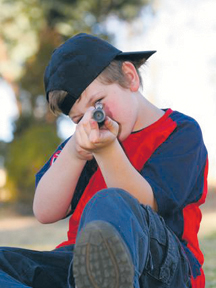
To my disappointment, an accidental screening of Indiana Jones’ Raiders of the Lost Ark recently piqued my twin six-year-old boys interest in toy guns. I was not prepared.
Thus far we’d avoided violent television shows, movies, and video games. I put my head in the sand for a few days and hoped that my little cherubs would return to their Legos and stuffed animals. But in fact, the issue spilled over into Halloween: they decided to dress as a policeman and a hunter.
It’s just a toy—or is it?
Looking around my home, I discovered that toy weapons had already crept in under my radar: foam swords, light sabers, ray guns, and bright orange monsters that shoot suction cups or foam balls. So why was I so upset? After all, we’re just talking about a toy, right?
Well, not exactly.
I had been unconsciously drawing the line at toys that looked like real guns. It turns out that theUniversityof Michigan Health System Web site agrees
with me. They suggest that playing with realistic toy guns could make it easier for your child to mistake a real gun as a toy. They recommend that any toy guns allowed in the home should be brightly colored.
Toy guns can also cause problems outside the home. One Portland, Oregon third grader was suspended earlier this year for accidentally bringing a four-inch G.I. Joe toy gun to school in his pocket. Since the Columbine shootings in 1999, school districts around the for toy weapons and the real thing. Whereever you land on this issue, be sure that you and your children clearly understand school rules. Develop a system to prevent toy weapons from accidentally ending up in your child’s backpack.
Family ideals
My husband and I decided that simply banning toy guns from our home wouldn’t fully address the future. Denial will be useless when our sons grow older and are exposed to gun play in their friend’s homes. Instead, we chose to balance setting limits that also left room for creative play. We wrote out our household policy, how they’re played with, including the consequences for breaking the rules.
Then we discussed it at a family-wide meeting.
We focused on dispelling the connectionbetween weapons and power; that there are more appropriate ways to solve problems. Our family agreed that we will practice peaceful confl ict resolution and encourage compassion and respect for others. The book, The War Play Dilemma: What Every Parent and Teacher Needs to Know by Diane Levin and Nancy Carlsson-Paige, was very our policy because explores several approaches.
Educate about firearm safety
A family friend and father of grown children suggested that we take advantage of their curiosity and teach our children
about firearm safety. Our public library offered two books appropriate for elementary school ages: Rachel Ellenburg Shulson’s Guns: What You Should Know and D.C. Dailey’s Guns are Not for Fun. We also found a DVD, Firearms Safety Education featuring McGruff theCrime Dog.
The National Rifle Association’s Eddie Eagle Gunsafe program recommends that we teach children these simple rules for what to do if
they find a fi rearm:
• Stop
• Don’t touch
• Leave the area
• Tell an adult
If you have a firearm in your own home, be sure it is unloaded, locked up, and that the ammunition is locked up separately from the weapon. Store the keys in a safe place out of reach of children.
Before develop a toy weapons policy that suits your family principles and then stick to it. Setting aside time to think through these controversial issues will ensure a safe and compassionate home environment for your children both now and as they grow into responsible adults.
LORRAINE WILDE is a freelance journalist living in the Pacific Northwest. She is a Kids.com and posts regularly on her blog at www.lorrainewilde.com. She is working on her memoir, Egg Mama: An Egg Donor and Her Extraordinary Family.

